
Power your home
with the sun.
Generate your own electricity, reduce your grid consumption and save on your electricity bills with an on-grid solar system — the simplest, lowest-complexity way to put your rooftop to work.
Your rooftop and the grid, working together.
An on-grid solar system is connected directly to the electricity grid. Your panels generate electricity during the day; your home uses that solar power first, and any additional electricity can be exported to the grid according to the applicable net-metering or settlement rules.
When solar generation isn't enough — early morning, evening, a cloudy day — your home simply draws electricity from the grid as usual. There's no switching, no interruption, and nothing for you to manage.
You generate what you can, use what you need, send the rest to the grid, and buy from the grid only when your system isn't producing. No batteries in the middle.
Five parts. One flow.
Solar Panels
Solar panels convert sunlight into DC electricity.
Inverter
The solar inverter converts DC electricity into usable AC electricity.
Your Home
Your appliances use the solar electricity generated.
Grid
Excess electricity can be exported to the grid under applicable regulations.
Electricity Meter
The applicable metering arrangement records electricity imported from and exported to the grid.
And that's the whole system
No batteries, no switching, nothing to operate. It runs itself.
Why choose on-grid solar?
Lower Electricity Bills
Generate a portion of your own electricity instead of purchasing all of it from the grid.
No Battery Required
Most on-grid systems operate without battery storage, reducing system complexity and upfront cost.
Make Use of Your Rooftop
Turn unused rooftop space into a source of electricity.
Long-Term Savings
A properly designed solar system can reduce electricity costs over many years.
Low Maintenance
With fewer components than battery-based systems, on-grid systems are relatively simple to maintain.
Government Support
Eligible residential systems may qualify for applicable government solar subsidies such as PM Surya Ghar.
On-grid solar is ideal when:
- You have a reliable grid connection
- You want to reduce electricity bills
- You have suitable rooftop space
- Most of your consumption occurs during the day
- You want a lower-complexity solar system
What happens when the grid goes down?
A standard on-grid solar system does not continue supplying your home during a grid outage. The inverter shuts down when the grid is unavailable — this is a deliberate safety measure that protects utility workers repairing the line.
Need backup power? Consider a hybrid solar system, or solar with battery storage.
What's in an on-grid system
Solar Panels
Generate electricity from sunlight.
Solar Inverter
Converts and manages the electricity generated by the panels.
Mounting Structure
Secures the solar panels to your rooftop.
DC & AC Cables
Carry electricity between the system components.
Protection Equipment
Helps protect the system and electrical installation.
Metering
Enables the applicable grid connection and electricity accounting arrangement.
The right system isn't necessarily the biggest system.
We size your solar system based on your electricity consumption, available rooftop space and requirements — not on what's easiest to sell.
The final price depends on:
| System | Suitable for |
|---|---|
| 1 kW | Lower electricity consumption |
| 2 kW | Small households |
| 3 kW | Typical residential requirements |
| 5 kW | Higher household consumption |
| 10 kW+ | Large homes / larger requirements |
Actual generation varies depending on location, sunlight, orientation, shading, system design and other factors.
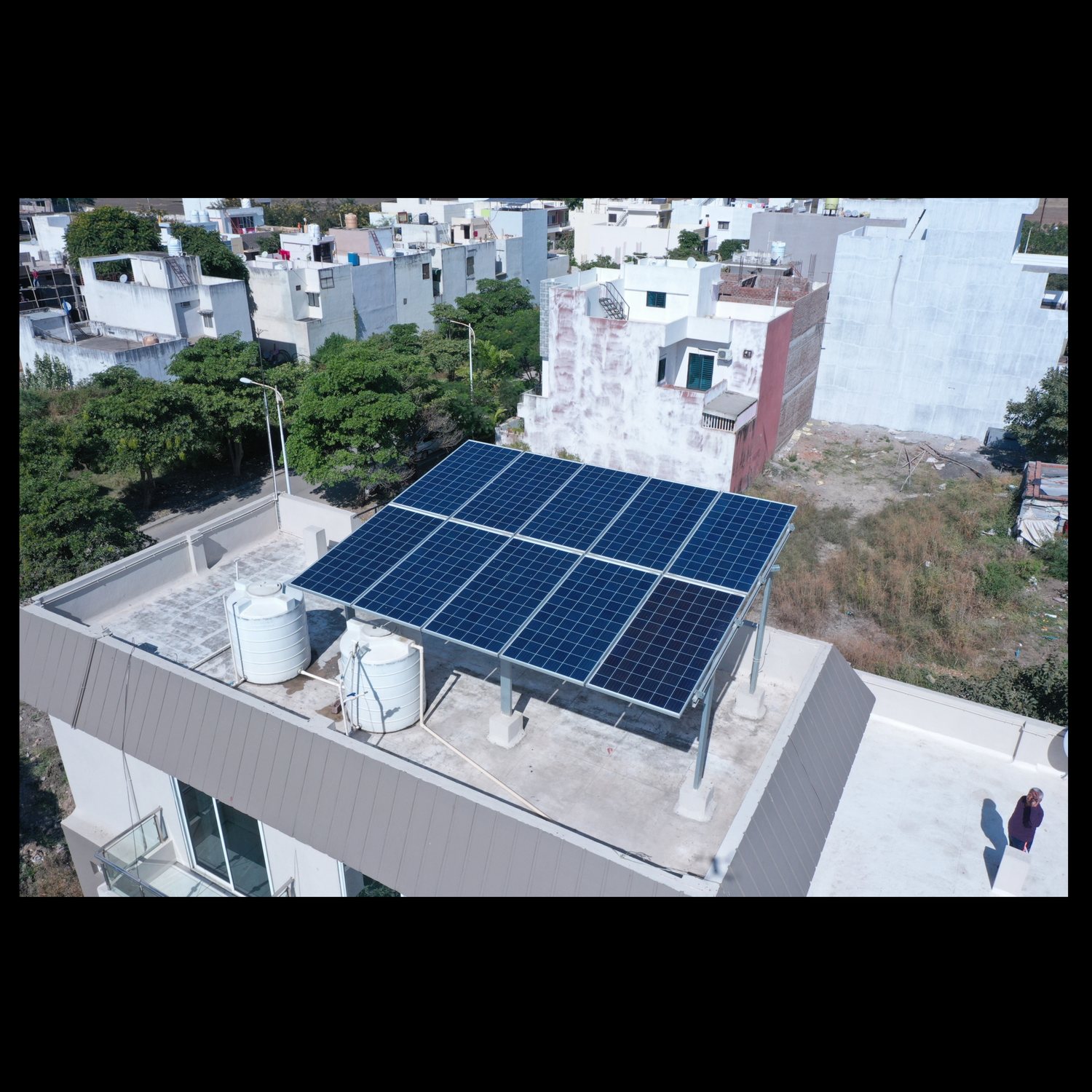
A residential rooftop, done properly.
Correct spacing, clean DC runs, a properly earthed structure and an inverter mounted where it can actually be serviced.
Which way your roof faces matters.
So does its tilt, and anything casting a shadow on it. Move the controls to see roughly how each one moves the number.
Indicative planning figures for roughly 23°N, relative to a south-facing array at the local optimum tilt. Real numbers come out of a site survey — shading in particular behaves very differently depending on what is casting it and when.
Where your electricity actually goes
When your system generates more than your property is using, the excess may be exported to the grid under the applicable metering arrangement. When you need more than you're generating, electricity is imported from the grid.
The exact billing, metering and settlement mechanism depends on your state and DISCOM regulations. We'll confirm what applies to your connection before you commit.
On-grid solar is the configuration the residential subsidy applies to.
Eligible residential customers can potentially receive government financial assistance under the PM Surya Ghar: Muft Bijli Yojana. For eligible residential installations, the current central subsidy can be up to ₹78,000.
Explore PM Surya Ghar →Eligibility depends on current government guidelines, your DISCOM and the equipment used. Off-grid systems are not covered by this residential subsidy.
How we install your on-grid solar system
Electricity Bill Analysis
We understand your current electricity consumption.
Site Assessment
We evaluate your rooftop, shading, orientation and electrical requirements.
System Design
We design a system around your property and energy requirements.
Proposal
You receive a clear project proposal and pricing.
Installation
Our team installs the panels, structure, inverter and electrical components.
Grid Connection
We complete the applicable DISCOM and metering requirements.
Commissioning
Your system is tested and brought into operation.
Support
We remain available for service and support.
On-grid vs off-grid vs hybrid
| On-Grid | Off-Grid | Hybrid | |
|---|---|---|---|
| Connected to grid | Yes | No | Yes |
| Battery required | Usually no | Yes | Yes |
| Backup during grid outage | No | Yes | Yes |
| Lower initial cost | Yes | — | — |
| Best for | Bill savings | Independent power | Savings + backup |
Not sure which one you need?
Talk to a Solar Expert →Solar designed around your home.
We don't believe in one-size-fits-all solar packages.
Proper System Sizing
Built from your actual consumption, rooftop and site conditions.
Quality Components
Panels, inverter, structure and electricals selected for the project.
Strong Mounting Structures
Engineered to hold up in the conditions they're installed in.
Professional Installation
Accurate alignment, safe electrical work, clean execution.
Clear Communication
You know what you're paying for and what to reasonably expect.
Reliable After-Sales Support
We're still here after the system is switched on.
Frequently asked questions
Turn your rooftop into your own power source.
Get a personalised solar assessment based on your electricity usage and property. Upload your latest electricity bill and we'll calculate the right system for you.
- System size from your actual consumption
- Subsidy eligibility checked for your connection
- No obligation, no pressure to buy
Get Your Free Solar Assessment
No CostOur solar expert will call you — honest advice, no pressure.
Thanks — we've got your details.
Our team will call you with a proper assessment. For anything urgent, call 1800 203 7191.
Ready to switch to solar?
Send us your latest electricity bill and let Archer Solar calculate the right system for your home — with the numbers explained.